Finding skilled technicians is harder than ever, with job boards delivering unqualified candidates and recruitment agencies charging high fees. Referral programs can solve this by leveraging your workforce to find pre-vetted hires faster and more effectively. Employees referred through these programs are hired 55% faster, stay 70% longer, and save businesses 80% in recruitment costs. Here’s how to create a program that works:
- Set Clear Goals: Focus on metrics like time-to-hire, retention rates, and referral-to-hire ratios.
- Engage Top Referrers: Identify employees with strong networks and offer meaningful recognition.
- Design Rewards: Use cash bonuses, PTO, or gift cards to motivate participation.
- Simplify the Process: Make referrals easy with mobile-friendly tools and minimal steps.
- Promote Continuously: Keep the program visible with reminders, contests, and recognition.
- Track and Improve: Monitor metrics and gather feedback to refine the program.
Referral programs reduce vacancies, improve retention, and cut costs while strengthening team dynamics. Our tools here at ServiceEmpire.AI can streamline the process, making it easier to build a reliable hiring pipeline.
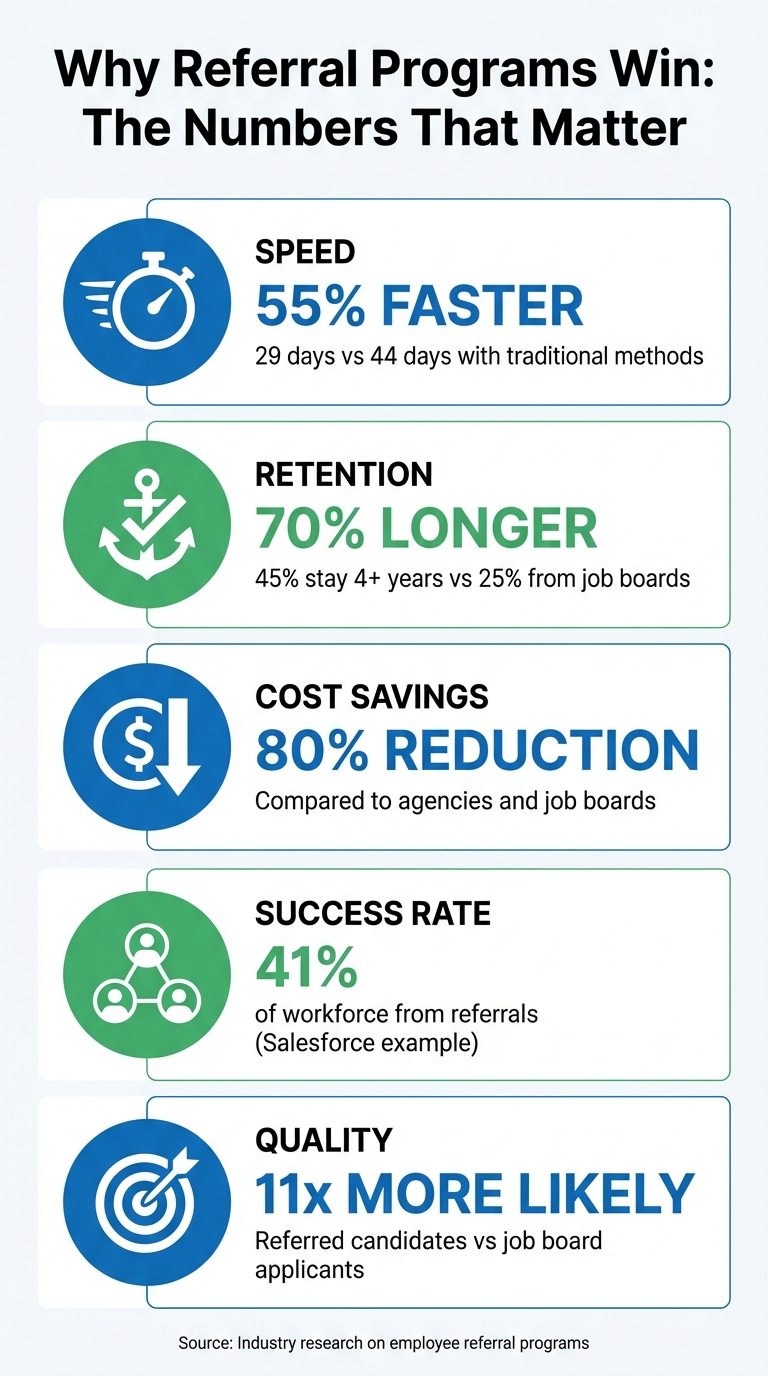
Employee Referral Program Benefits: Key Statistics for Hiring Success
Step 1: Set Clear Goals for Your Referral Program
A referral program without clear goals is like setting out on a journey without a map, you won’t know where you’re headed or how to measure progress. Defining your objectives gives your program purpose and helps track its success.
"The first step to creating any great referral program, like the first step of anything, is having a clear vision of what it should accomplish."
Start by identifying the metrics that directly address your hiring challenges. For instance, if positions are staying vacant for too long, focus on tracking time-to-hire. If high turnover is an issue, measure retention rates at six months and one year. And if you’re drowning in unqualified applications, monitor your qualified referral rate, that is the percentage of referred candidates who make it to the interview stage.
Choose Recruitment Metrics That Matter
For field service businesses, some of the most useful metrics include:
- Referral-to-hire ratio: How many referrals turn into actual hires.
- Time-to-hire: The number of days from application to hire.
- Retention rate: How long referred hires stay with your company.
- Employee participation: The percentage of your workforce actively submitting referrals.
If your organization is smaller, you might start with just a couple of metrics, like quality of hire and time-to-hire, and expand as your program grows.
Align Goals with Business Needs
Once you’ve chosen your metrics, make sure they align with your company’s priorities. For example, if you’re short on licensed electricians but have plenty of HVAC technicians, focus your efforts on electricians. You could offer higher bonuses for those referrals or send out more frequent reminders. Be specific in your objectives. Something like “increase the percentage of HVAC technician hires from referrals from 10% to 20% over the next six months” is far more actionable than a vague goal.
If your business has seasonal peaks, like a surge in HVAC work before summer, consider running a short-term referral campaign a couple of months ahead of your busy season. We have a full article dedicated to how to forecast crew needs for your home service business. This not only optimizes your recruiting budget but also creates urgency among employees to act quickly.
With your goals firmly in place, the next step is to engage your top referrers and keep the momentum going.
Step 2: Find and Engage Your Best Referrers
Some technicians have built extensive networks over years in the field, while others are just starting out. The key is identifying those with the strongest connections and encouraging them to share their contacts.
Identify Employees With Strong Networks
Start by analyzing your historical referral data, whether through your ATS or even simple spreadsheets, to spot "repeat referrers" and top-performing technicians who consistently recommend skilled professionals. Don’t overlook newer hires either; their connections are often fresh and untapped. Employees active on LinkedIn or industry forums can also be goldmines for referrals.
Timing is everything. Encourage new employees to refer former colleagues within their first 30 days, while those relationships are still active and relevant. This proactive approach can uncover high-quality candidates who might otherwise slip through the cracks.
Once you’ve identified your referral superstars, the next step is keeping them engaged with meaningful feedback and rewards.
Recognize and Reward Top Contributors
Failing to acknowledge referrals is a surefire way to discourage participation. When someone takes the time to recommend a candidate, they expect updates - quickly. A simple message like, "We're reviewing John's application this week", can make a big difference.
Public recognition can be even more impactful. For example, GoDaddy boosted their referral rate from 17% to 33% by focusing on recognition rather than cash bonuses. Instead of increasing payouts, they lowered them from $3,000 to $1,000 and gave employees hand-held mirrors engraved with thank-you messages for their recruiting efforts. Similarly, PURE Insurance generates 40% to 60% of new hires through referrals by celebrating successful referrers during company meetings.
You can also foster healthy competition by introducing internal leaderboards that track which employees or departments submit the most qualified referrals. This keeps the program visible and motivates participation.
Finally, reward contributions at key milestones, like when a candidate is interviewed or completes 90 days on the job. This approach keeps your referrers engaged throughout the hiring process and shows you appreciate their efforts, even before a hire is finalized.
Step 3: Design Your Incentive Structure
Once you’ve got your referrers ready to participate, the next step is creating an incentive structure that gets results. A well-thought-out reward system turns good intentions into action. Your incentives should be enticing enough to encourage participation while staying within your budget. A solid plan should benefit both your current employees and the candidates they bring in.
Rewards for Current Employees
Cash bonuses are a proven way to incentivize referrals. For standard technician roles in fields like HVAC, plumbing, or electrical work, offering $500–$1,000 per successful hire works well. For more specialized positions, such as master electricians, consider increasing the bonus to $1,000–$2,000 or more.
To safeguard your investment, split payouts into milestones. For example, Salesforce provides a $2,000 bonus for successful referrals, a strategy that has driven 41% of their workforce growth through referrals and resulted in $7 million in bonuses paid as of May 2025. A smart approach is to split payments: half at the time of hire and the other half after the probation period to ensure the new hire is a good fit.
Non-cash rewards can be equally effective. Offering extra paid time off (PTO) is a great option, it costs less than cash and appeals to employees who value work-life balance. Gift cards ranging from $100–$200 also work well as spot rewards, especially when a referred candidate reaches milestones like the interview stage, keeping employees motivated and engaged.
Once you’ve set up rewards for employees, it’s time to focus on attracting new hires.
Bonuses for New Hires
Sign-on bonuses are an excellent way to draw in skilled technicians. These can range from a few hundred dollars for entry-level roles to several thousand for experienced professionals. Tailor the bonus amount to the position’s level of expertise to make it worthwhile.
Compare Different Incentive Types
Here’s a quick breakdown of various incentive options to help you decide what works best for your program:
Consider experiential rewards if you’re looking to add a fun and memorable twist to your referral program. While these rewards can be pricier upfront, they create excitement and generate buzz, keeping your program top of mind.
Step 4: Create an Easy Referral Process
Even the most appealing incentives won’t matter if your employees find the referral process too complicated. The key is straightforward: the easier it is for employees to refer someone, the more likely they are to do it. Keep the process simple and rely on automation to handle tracking. This approach transforms good intentions into actual hires.
Make Submissions Simple
Ditch the paperwork and overly complicated forms. Your employees are busy, especially technicians who are often out in the field. Use mobile-friendly tools such as QR codes, quick referral links, or dedicated mobile apps. These tools should allow employees to submit a referral in under two minutes, even while they’re on the move.
Keep the information you request minimal: just the candidate’s name, email, and phone number, along with the referring employee’s name and ID. Skip asking for a resume upfront to lower barriers. Your recruiting team can handle follow-ups and request additional documents later. This approach has proven effective for companies like Salesforce, which mentioned above, has built 41% of its workforce through referrals. They use a dedicated app that streamlines submissions and ensures every referred candidate is contacted within seven days.
To make it even easier, provide pre-written templates for social media posts and emails. This allows employees to share job openings without the hassle of crafting their own messages. The simpler you make it, the more referrals you’ll receive.
Track Referrals Automatically
Once submissions are simplified, the next step is automating the tracking process. Manual tracking often leads to delays and frustration. Instead, use an Applicant Tracking System (ATS) like Greenhouse or Workable to monitor each referral’s progress seamlessly. Set up automated notifications (via email or text) to keep employees updated at every stage, whether it’s “application reviewed,” “interview scheduled,” or “hired.”
"The single worst mistake a company can make with its referral program is to not contact referred candidates when an employee expects them to. If that happens, it's unlikely that employee will refer someone else." - Kara Yarnot, President, Meritage Talent Solutions
Transparency is key to maintaining trust. GoDaddy, for example, simplified their referral process and saw employee referral rates jump from 17% to 33%, even after reducing their cash bonus from $3,000 to $1,000. The takeaway? A smooth, hassle-free process outperforms a bigger payout every time.
Step 5: Launch and Promote Your Program
Announce the Program Launch
The way you launch your program can set the stage for its success. Make it memorable by introducing it during an engaging company event: think all-hands meetings, happy hours, or even a casual team lunch. These settings help cut through the noise of digital communication. To underline its importance, have a senior leader, like your CEO or a VP, announce the program. This not only signals that it’s a company-wide priority but also strengthens team involvement and alignment.
PURE Insurance nailed this approach by tapping into the enthusiasm of new hires. They encouraged all new employees to refer candidates within their first month on the job. The results? A staggering 40% to 60% of their new hires came from referrals. You can take a similar approach by hosting quick training sessions during the launch. Use these sessions to explain the referral process, describe the kind of candidates you’re looking for, and set clear expectations about follow-up communication after a referral is submitted. Keep the process so straightforward that employees can explain it in 30 seconds or less.
Once you've made a strong first impression, the next step is keeping the program top of mind.
Keep the Program Visible
A successful launch is just the beginning; maintaining interest is where the real work begins. Use a variety of channels to ensure the program stays visible. Weekly emails announcing new job openings, reminders on internal messaging platforms, posters in break rooms, and mentions during shift updates are all effective ways to keep it on employees' radars. For mobile employees, text reminders via scheduling apps can be a great way to notify them about open roles and referral bonuses.
You can also inject some fun into the process with gamification. For instance, one company recognized as a "Bay Area Best Place to Work" ran a five-month referral contest that featured an internal leaderboard. Monthly winners earned exciting experiential rewards, like skydiving trips. This creative strategy resulted in 700 new referrals and pushed their referral hire rate from 18% to 25%. Public recognition is another powerful motivator. Highlight employees who successfully refer candidates in newsletters or team meetings. This not only celebrates their contributions but also inspires others to participate, creating a ripple effect of engagement.
Step 6: Track Results and Make Improvements
Once your referral program is up and running, the work doesn’t stop there. To keep it effective, you need to monitor its performance and tweak it as needed.
Keep an Eye on Key Metrics
To understand how well your program is working, focus on five important metrics: referral quality rate, time-to-hire, cost-per-hire, participation rates, and retention rates at 6 months, 1 year, and 3 years.
Start with the referral quality rate. This is the percentage of referred candidates who pass the initial screening and qualify for interviews. A high rate here indicates that employees understand the type of technician you’re looking for. Next, compare time-to-hire for referrals versus other hiring methods. On average, referrals are hired 55% faster than candidates from traditional channels.
For cost-per-hire, calculate the total program expenses (including bonuses) and compare them to what you’d spend on job boards or recruiters. Referral programs often cut recruitment costs by up to 80%. Participation rates are another key metric; tracking these across departments can reveal which teams are actively engaged and which might need more encouragement. Finally, monitor retention rates, as referred employees tend to stay 70% longer than those hired through other means.
Reviewing those metrics quarterly can help you spot early signs of trouble, like low participation or slow hiring times, and make quick adjustments.
Gather Employee Feedback
Numbers tell part of the story, but direct feedback from your team fills in the gaps. Regularly survey employees or hold short meetings to gauge their thoughts on the program. Ask them questions like: Are the rewards appealing? Is the submission process straightforward? Are they kept in the loop about their referrals?
Here’s a key insight from Kara Yarnot, President of Meritage Talent Solutions:
"The single worst mistake a company can make with its referral program is to not contact referred candidates when an employee expects them to. If that happens, it's unlikely that employee will refer someone else."
PURE Insurance takes a proactive approach by reaching out to new hires within their first month. They ask what motivated them to join and gather suggestions for improvement while enthusiasm is still fresh. This strategy has helped them secure 40% to 60% of their new hires through referrals.
Also, pay attention to indirect feedback. For example, if participation suddenly drops or a department goes quiet, it might mean employees need clearer instructions on what makes a strong candidate.
Adjust Rewards and Streamline Processes
Use the data and feedback you’ve gathered to fine-tune your program. If participation is low but the quality of referrals is strong, your incentives might not be enough. Consider increasing bonuses for harder-to-fill roles, such as master electricians or commercial HVAC technicians. Standard bonuses for entry-level positions usually range from $500 to $1,000, while more specialized roles may warrant $2,000 to $3,000.
If you’re getting a lot of referrals but the candidate quality is lacking, it might be time to refine your criteria. You could also split bonus payments to encourage long-term retention - pay part at the time of hire and the rest after the new hire completes 90 or 180 days on the job.
Don’t forget to simplify the referral process itself. If your Applicant Tracking System (ATS) is overly complicated, streamline it. For example, allow employees to submit just a candidate’s name and phone number to get started. The easier it is to participate, the more referrals you’re likely to receive.
Long-Term Benefits of Referral Programs
A well-executed referral program can evolve into a reliable hiring engine that consistently delivers strong results. Data shows that 45% of referral hires remain with their companies for at least four years, compared to just 25% of hires from job boards. This improved retention not only reduces turnover costs but also helps build a stable, experienced team.
Referral programs also encourage a sense of ownership among employees. When technicians actively refer candidates, they naturally become more invested in the company’s success. They’re more likely to mentor new hires and hold them accountable, knowing they personally recommended them. This creates a supportive environment for new employees, helping them navigate the challenges of their early days on the job while giving them an immediate sense of belonging.
How ServiceEmpire.AI Supports Your Hiring
These long-term advantages align perfectly with the tools offered here at ServiceEmpire.AI. Our platform provides free, AI-driven solutions to simplify your hiring process. It helps you create compelling job descriptions and setup referral tracking. You can develop onboarding processes, training programs, and manage bonus eligibility - no credit card required.
ServiceEmpire.AI also ensures seamless communication with your team, especially field workers. Whether you’re announcing a referral program or sending reminders, we can help you develop the SOPs that keep everyone in the loop. Explore these tools and access over 100 expert articles on hiring, leadership, and fostering a referral-driven culture.
Conclusion
When you have a reliable referral program for hiring, it makes scaling your field service business that much easier. Great people will refer more great people.
As for the bottom line, the financial benefits of referral programs grow over time. While the average recruiting cost per hire is around $4,000, referral programs help you hire faster (29 days versus 44 days with traditional methods) and attract better candidates, who are 11 times more likely to be hired than those applying through job boards.
With those kind of numbers, you can't afford to keep waiting. Build your referral program for hiring today.
FAQs
What metrics should you track to ensure your referral program is successful?
To gauge how well your referral program is performing, you'll want to keep an eye on a few critical metrics that can guide your strategy. Start with the participation rate - this tells you how many employees are actively recommending candidates. Another key metric is the referral-to-hire conversion rate, which measures how often those referrals turn into actual hires. It’s also worth comparing the cost per hire (CPH) for referred candidates against other hiring sources to see if the program is providing good value.
Looking beyond immediate results, consider tracking employee satisfaction with the program and the retention rates of referred hires. These indicators can reveal if the program is fostering long-term success and helping you bring in candidates who align well with your company culture. By focusing on these metrics, you can ensure your referral program is not only effective but also supports your broader hiring objectives.
How can I keep employees motivated to participate in the referral program long-term?
To keep your referral program active and effective, prioritize consistent engagement and clear communication. Show employees how their referrals make a difference - whether it's bringing in talented technicians, boosting team performance, or increasing profitability. When they see the direct impact, they’ll be more motivated to participate.
Offer a mix of incentives that employees will appreciate, such as cash bonuses, extra PTO, or gift cards. For roles that are harder to fill, consider offering even bigger rewards. Recognize their efforts with team shoutouts or fun initiatives like a quarterly "Referral Champion" award. And make the process easy. Provide a simple referral form and automated updates so employees can track the progress of their referrals effortlessly.
ServiceEmpire.AI can make managing your referral program easier and more effective. Use its free AI tools to craft engaging referral emails, create hiring prompts, and monitor performance metrics. By automating these tasks, you’ll have more time to focus on rewarding your team and keeping a steady stream of top talent coming through the door.
What are the best incentives to encourage employees to make referrals?
When it comes to encouraging employees to refer talented candidates, the right incentives can make all the difference. Some popular options include cash bonuses, tiered monetary rewards, gift cards, extra paid time off, or even memorable experiences like vacations. For those who value giving back, offering a charitable donation option can also be a meaningful choice.
The key to success lies in understanding what motivates your team. Some might be drawn to the immediacy of cash rewards, while others could prioritize extra time off or unique experiences. By tailoring the incentives to match your employees’ preferences, you can increase participation and enthusiasm in your referral program.
End the Cycle of Employee Turnover and Burnout