When deciding between upskilling your team or hiring new talent, the choice depends on your immediate needs and long-term goals. Here's the key takeaway:
- Upskilling: Costs less (around $1,252–$5,000 per employee) and improves retention (53% lower turnover). It’s ideal for building expertise within your existing team and preparing for future demands, though it requires time (8–12 weeks for full productivity).
- Hiring: Offers immediate access to specialized skills but is more expensive (averaging $4,700+ per hire, excluding onboarding costs) and risky (21% of new hires leave within the first year). It’s best for filling urgent gaps or handling peak workloads.
Quick Comparison
Bottom Line: Upskilling is more cost-effective and retains institutional knowledge, while hiring fills immediate needs but comes with higher costs and risks. A balanced approach of training your current team while hiring for specialized roles often delivers the best results.
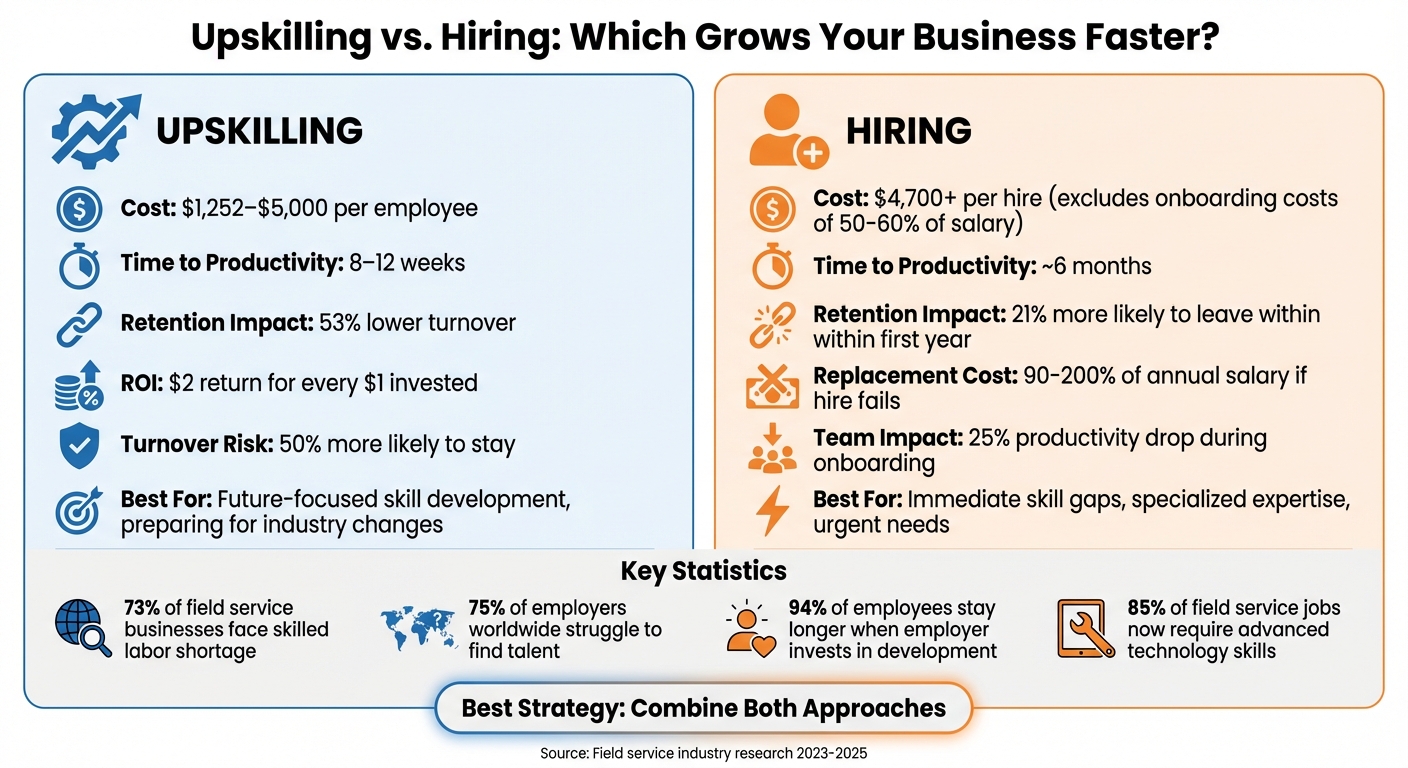
Upskilling vs Hiring Cost and ROI Comparison for Field Service Businesses
What is Upskilling?
Upskilling is all about helping employees grow their skills to keep up with the changing needs of your business. It builds on their existing expertise, ensuring they can adapt to new technologies, shifting customer expectations, and industry trends.
In field service, this could mean training HVAC technicians to handle IoT-enabled smart thermostats, teaching electricians to work with solar systems, or showing plumbers how to use AI tools to predict pipe failures.
The numbers tell a compelling story: over 70% of field service companies report a skills gap on their teams, and new technologies are expected to disrupt 44% of workers' skills within the next five years. While your technicians may already excel at traditional repairs, upskilling helps them evolve into tech-savvy professionals who can manage IoT devices, interpret real-time data, and explain the benefits of predictive maintenance. This shift prepares your team to tackle the ever-changing demands of the field service industry.
Benefits of Upskilling
Upskilling is good for your team and it's good for your bottom line. It's often more cost-effective and retention-friendly than hiring new employees. Your current team already knows your systems, customers, and company culture. Companies that invest in employee development see 53% less turnover, and 94% of employees say they'd stick around longer if their employer supported their growth. Real-world examples highlight the impact:
When Vodafone trained its technicians in IoT device management and data analysis in 2025, they turned their workforce into proactive problem-solvers who could predict equipment failures before customers even noticed. Similarly, Smart Care Equipment Solutions created clear career paths for technicians, offering opportunities in management, training, or sales. This approach not only reduced downtime but also made employees feel valued and motivated.
Upskilling also gives your business more flexibility. Cross-training your team means you can adjust resources to meet changing demands without rushing to hire.
Upskilling also gives your business more flexibility. Cross-training your team means you can adjust resources to meet changing demands without rushing to hire. Neil McGeoch, Senior Advisory Solution Consultant at ServiceNow, explains it well:
"Upskilling evolves roles so employees can focus on higher-value tasks that require human judgment, creativity, and empathy."
Challenges of Upskilling
Despite its benefits, upskilling comes with its own set of hurdles. Training costs can add up, especially when scaling initiatives across a large team. Plus, training takes time, whether it's through manufacturer training centers like Carrier's facilities or microlearning platforms. This can temporarily impact productivity as employees step away from their regular work.
Another challenge is employee adaptability. Not everyone will immediately embrace new tools or methods, which is why fostering a supportive, learning-focused environment is so crucial. Given the rapid pace of technological change, upskilling isn't a one-and-done effort. It requires a long-term commitment, woven into your company culture, to stay effective in the face of ongoing advancements.
What is Hiring New Talent?
While upskilling focuses on developing your current workforce, hiring brings in external expertise to fill immediate skill gaps. Hiring new talent means bringing in professionals from outside your organization who already possess the specific skills, technical know-how, or industry experience you need. It's a fast way to address urgent needs when in-house expertise falls short. We'll dive into some specifics here, but we also have a whole service business hiring checklist if you need it.
For instance, imagine you urgently need an HVAC technician skilled in commercial refrigeration or an electrician certified in solar panel installations. Hiring externally ensures you get someone who can hit the ground running. This is especially critical during peak demand periods, like summer cooling seasons or after a major storm. Beyond filling gaps, external hires often infuse fresh ideas and perspectives that can breathe new life into outdated processes. Many hiring managers follow the "70% Rule", which suggests hiring candidates who meet at least 70% of the job requirements and then providing training to close the remaining skill gaps:
"You take action on any decision when you have 70% confidence in the success of the decision." – Ron Sharon, SVP of IT and Security
Hiring is a fast-track solution for gaining specialized skills and expertise when time is of the essence. However, it’s not without its challenges. Let’s explore the key benefits and drawbacks.
Benefits of Hiring
One of the biggest advantages of hiring externally is the immediate access to expertise. This allows new hires to contribute right away. As Tim Smith, Executive Partner at Stratfield Consulting, puts it:
"For highly technical or senior roles, hiring someone with the exact skill set can save time and ensure immediate impact."
This speed is invaluable when scaling operations during busy seasons or seizing new market opportunities. External hires don’t just bring the technical skills you need, they can also introduce innovative approaches gained from working in different environments. Additionally, hiring externally gives you the flexibility to expand your team’s capacity without overburdening your existing staff.
That said, hiring does come with its own set of challenges, from financial costs to cultural adjustments.
Challenges of Hiring
Hiring new talent isn't cheap or easy. Recruitment costs can add up quickly, averaging around $5,000 per hire. If you work with external recruiters, their fees typically range from 20% to 25% of the new hire's first-year salary. Onboarding adds another layer of expense, often totaling 50%–60% of the new hire's salary. And if the hire doesn't work out, turnover costs can skyrocket to 90%–200% of the original investment.
The process also takes time. On average, hiring can take up to 49 days, and even then, new employees often need additional time to adjust before reaching full productivity. External hires are also 21% more likely to leave within their first year compared to internal promotions. As of April 2025, 34% of small business owners reported struggling to fill job openings, with 47% citing a lack of qualified applicants.
Cultural fit is another hurdle. A misaligned hire can disrupt team dynamics, so it's essential to assess cultural compatibility just as thoroughly as technical skills.
Hiring can bring immediate benefits, but it's not without risks or costs. Balancing these factors is key to making the right decision for your team.
Cost Comparison: Upskilling vs. Hiring
Let’s break down the numbers to better understand the costs of upskilling current employees versus bringing in new hires.
Upskilling an existing employee for a technical role usually costs around $5,000 per person. On the other hand, hiring a new employee for a standard position averages $4,700. At first glance, these figures seem comparable, but the real story unfolds when you consider the hidden costs.
The Hidden Costs of Hiring
Hiring new employees comes with several additional expenses. Recruitment agencies, for instance, charge 15% to 25% of the new hire’s annual salary. Then there’s onboarding, which can cost 50% to 60% of their first-year salary. During this period, you’re paying a full salary while the new hire’s productivity remains low. To make matters worse, your existing team’s output often drops by about 25% as they help the new hire get up to speed.
The Predictability of Upskilling
Upskilling costs are far more straightforward. In 2023, companies spent an average of $774 per trainee, with small businesses investing slightly more at $1,047 per trainee. Unlike new hires, upskilled employees already understand your systems, customers, and workplace dynamics, which means they can reach full productivity within 8 to 12 weeks.
The Long-Term Financial Impact
The long-term costs of hiring can be staggering if things don’t work out. Replacing a failed hire can cost anywhere from 90% to 200% of their annual salary. Upskilling, by contrast, tends to reduce turnover. Companies that prioritize employee training experience 53% less attrition, saving both time and money.
The table below offers a side-by-side comparison to make these cost differences even clearer.
Cost Comparison Table
While both approaches come with their own costs, the long-term benefits of upskilling, like reduced attrition and faster productivity gains - can make it a more predictable and cost-effective choice for many businesses.
Which Strategy Drives Faster Business Growth?
When it comes to growth strategies, hiring and upskilling each offer distinct advantages, timelines, and outcomes. Hiring brings immediate expertise to the table, while upskilling focuses on building long-term capabilities. Both approaches have their place, depending on your business needs.
If your business requires specialized skills right now (say, a master electrician for complex installations or an HVAC technician familiar with geothermal systems) hiring is the quickest solution. A new hire can start contributing almost immediately, filling gaps in your team's expertise and opening up new revenue opportunities. However, it’s worth noting that new employees typically take around six months to reach full productivity.
On the other hand, upskilling takes a bit more time upfront but offers more lasting benefits. Your current team already knows your customers, systems, and processes, which means they can adapt to new skills faster. Upskilling programs often get employees fully productive in 8 to 12 weeks, compared to the six months commonly needed for new hires. Plus, investing in your team boosts loyalty and strengthens customer relationships.
The financial benefits of upskilling are also compelling. In January 2025, Booz Allen Hamilton revealed that its multi-year upskilling program, training 25,000 employees across 80+ locations, resulted in a 4% increase in billable hours, an 11% boost in talent retention, and a 94% proficiency rate among 1,400 participants. These numbers show that investing in your existing workforce can lead to measurable growth while fostering a more resilient team.
Ultimately, the choice between hiring and upskilling depends on whether you’re addressing an immediate challenge or planning for the future. Hiring can quickly fill urgent gaps or seize time-sensitive opportunities, while upskilling builds a loyal, adaptable team ready to grow alongside your business. Many successful business owners use a combination of both strategies to balance short-term needs with long-term goals.
Short-Term Growth vs. Long-Term Sustainability
From a financial perspective, hiring and upskilling offer very different benefits. Hiring provides an immediate boost to revenue, while upskilling creates a more stable and capable workforce over time.
For example, hiring a seasoned plumber with backflow prevention certification or an HVAC tech with EPA 608 credentials means they can start generating revenue almost immediately. This is particularly valuable when entering new markets, tackling large-scale projects, or meeting tight deadlines. However, hiring often comes with higher upfront costs and no guarantee that the new employee will stick around once the immediate need is met.
Upskilling, while slower to deliver immediate results, pays off in the long run. Training your existing team not only equips them with new skills but also fosters a culture of growth and loyalty. In industries like field services, where relationships and institutional knowledge are key, retaining skilled technicians can be a game-changer.
The numbers back this up. Between 2023 and 2024, SAP implemented an upskilling program with personalized learning paths for employees. Within a year, account executives who completed the training outperformed their peers by 55.5%. Similarly, Amazon’s "Upskilling 2025" initiative invested $1.2 billion to train 300,000 employees for higher-skill roles, with some participants reporting salary increases of up to 40%. These examples highlight how upskilling can drive both immediate performance gains and long-term workforce readiness.
Scalability for Seasonal Demands
Seasonal fluctuations are a reality for field service businesses. HVAC companies brace for summer surges, plumbers prepare for winter emergencies, and landscapers gear up for spring and fall. The big question is: Should you hire additional help during peak times or upskill your team ahead of the rush?
Upskilling works best when you can anticipate demand. For example, if your HVAC business expects a busy June, you could start cross-training your installation technicians on maintenance and repair by March. This proactive approach ensures your team is ready to handle the workload when the busy season hits, all while keeping labor costs consistent and avoiding the last-minute scramble for temporary staff.
Hiring, on the other hand, is ideal for unexpected demand spikes or when your team simply can’t meet the workload. Temporary staffing allows you to scale up quickly without long-term commitments. Temps often bring relevant experience, so they can contribute almost immediately. However, integrating new workers into your systems and culture during peak periods can sometimes create friction.
"When you decide to invest in a worker, you have already built the relationship and made them part of your talent pipeline, while other employers are starting their recruitment process from scratch." - PeopleReady
For many businesses, a hybrid approach works best. Upskill your core team to handle predictable demand cycles, and bring in temporary workers when workload exceeds capacity. Keeping a database of reliable seasonal workers and offering incentives for them to return can also reduce future hiring costs and time.
To streamline both hiring and upskilling strategies, tools like ServiceEmpire.AI can be invaluable. This free AI-powered platform is tailored for field service operations, helping you craft effective hiring prompts, create ad campaigns, and develop trade-specific SOPs. With resources like these, you can build a workforce that’s ready to tackle both immediate challenges and future growth opportunities.
Field Service-Specific Considerations
Field service businesses face unique challenges, including a 73% skilled labor shortage and an aging workforce, which make the decision between upskilling existing employees and hiring new ones even tougher. Finding qualified candidates externally has become more challenging and expensive, while the retirement of experienced technicians is leading to a loss of critical, field-specific expertise.
In trades like HVAC, plumbing, and electrical work, licensing and certification requirements add another layer of complexity to staffing decisions. According to research, 45% of workers willing to change jobs cite the need for different credentials, licensing, or skills as their biggest hurdle. Hiring someone already equipped with the necessary certifications is no easy task, and training an existing employee to meet those standards takes time. That said, offering internal certification pathways can open the door to hiring less experienced candidates from non-traditional backgrounds and training them, which broadens your talent pool
Technology is also reshaping the field service landscape. Nearly 85% of jobs in manufacturing and field service now require advanced technology skills. By 2033, these sectors could face a shortfall of 1.9 million workers. The work is shifting from hands-on, manual tasks to roles that rely on data and AI-driven tools. In many cases, it’s more practical to invest in upskilling your current workforce to handle these technological demands than to compete for a shrinking pool of tech-savvy candidates.
Seasonal fluctuations in demand add yet another challenge. For instance, summer often brings a surge in HVAC service calls, while winter sees a spike in plumbing emergencies. Cross-training your team during slower months can create a more flexible workforce, capable of stepping into different roles as workloads shift. However, during peak seasons, when immediate expertise is needed, hiring externally may be the only option if there’s no time to train someone internally.
To navigate these complexities, tools like ServiceEmpire.AI can be invaluable. This free platform offers resources such as trade-specific SOP generators, hiring prompts to attract top talent, and leadership frameworks, all created by professionals with experience scaling service businesses to nine figures. Whether you’re focused on upskilling your team or onboarding new hires, having the right tools can make the process faster and more efficient.
The Hybrid Strategy: Combining Upskilling and Hiring
Field service businesses often find success with a balanced approach: combining upskilling their current workforce with hiring new talent. This strategy not only cultivates loyalty and adaptability through training but also ensures immediate gaps are filled by bringing in specialists. Tim Smith, Executive Partner at Stratfield Consulting, puts it succinctly:
"The decision between upskilling and hiring depends on your organization's goals, timeline, and resources... it's critical to leverage both strategies for growing your team."
Start by auditing your workforce to pinpoint which skills can be developed internally and which require external expertise. This approach creates a foundation for growth, addressing current operational needs while preparing for future challenges.
When to Focus on Upskilling
Upskilling works best when preparing your team for industry shifts or when you want to boost retention. As technologies like smart home systems and IoT-enabled diagnostics transform the field, training your current technicians equips them with new capabilities while retaining their institutional knowledge.
The data backs this up. Companies that prioritize employee development enjoy higher retention rates and lower replacement costs. In a hybrid strategy, this retention reduces the long-term expenses tied to constant external hiring. Additionally, cross-training during slower periods can create a more versatile team, ready to handle spikes in demand.
When to Prioritize Hiring
There are times when hiring is the only viable option. When immediate customer demands or severe technician shortages arise, or when your team lacks specialized skills altogether. While upskilling generally takes 8 to 12 weeks to show results, some roles require expertise that simply can't be developed internally in time. For instance, advanced cybersecurity for smart building systems or knowledge of new refrigerants in HVAC often necessitate external recruitment. Even if new hires need a six-month ramp-up period, hiring seasoned professionals is often faster than building those skills from scratch.
Integrating Both Strategies
To get the best of both worlds, combine the strengths of these two approaches. Start with a skills gap analysis to identify training opportunities for your current team and determine where external hires are essential. For example, tools like ServiceEmpire.AI can simplify this process by offering trade-specific SOP generators and tailored hiring prompts. Their management frameworks, developed by operators who scaled to nine-figure businesses, help integrate new hires while advancing the skills of existing employees. You can explore these resources here on our website with no credit card required.
The numbers speak volumes: every $1 spent on upskilling delivers a $2 return. By blending internal training with strategic hiring, you not only build immediate capacity but also ensure long-term stability. This dual approach reduces reliance on external talent, lowers turnover costs, and keeps your business agile - ready to succeed in both steady and unpredictable markets.
Conclusion
Deciding between upskilling your team and hiring new talent isn’t an either-or situation - most field service businesses benefit from using both strategies. On average, upskilling costs around $954 per employee, while hiring a new team member can set you back $4,700, not including recruitment expenses. But when you're up against tight deadlines or need specialized skills right away, hiring often becomes the quicker solution.
Start with a skills gap analysis to determine which areas to strengthen internally and where external expertise is necessary. If you're preparing for industry changes, upskilling your current team not only builds new skills but also retains valuable institutional knowledge. However, when technician shortages or immediate demands for advanced skills arise, hiring externally fills those gaps efficiently. This balanced approach helps you create a workforce strategy that’s both cost-effective and adaptable.
Blending upskilling with hiring ensures you meet immediate needs while preparing for the future. Research shows that balanced strategies can reduce employee turnover by 53% and generate $2 for every $1 invested. Meanwhile, with 75% of employers worldwide struggling to find talent, external recruitment has become more competitive and expensive. By combining these approaches, you can lower turnover costs, quickly address skill shortages, and build a workforce that’s ready for long-term challenges. For field service businesses navigating rapid change, this dual strategy strengthens your ability to stay ahead.
To make this process easier, ServiceEmpire.AI offers free, trade-specific tools designed by operators who’ve scaled businesses to nine figures. From generating hiring prompts to attract top talent, to creating SOPs that streamline training, and leadership frameworks that integrate new hires while developing your current team - these resources are all available at https://serviceempire.ai. No credit card required, just practical tools that deliver results for field service businesses.
FAQs
How do I decide between upskilling my team and hiring new employees?
Deciding whether to upskill your current team or bring in new hires boils down to three main factors: cost, urgency, and long-term impact. Hiring new employees can be expensive, with costs like recruiting fees, onboarding, and training potentially reaching 3–4 times the annual salary for just one role. Upskilling, however, usually requires a smaller investment since it builds on your team’s existing knowledge and payroll structure.
You’ll also need to weigh the urgency and depth of the skill gap. If the gap is relatively small and can be closed through training, upskilling is a more budget-friendly option that also preserves your team’s institutional knowledge. Plus, it can give a boost to morale. On the flip side, if the gap is substantial or demands expertise that would take too long to develop in-house, hiring might be the quicker solution.
Lastly, consider the impact on employee engagement and retention. Providing opportunities for growth through upskilling can enhance morale and lower turnover, especially in small businesses where close-knit teams often lead to stronger loyalty. Tools like ServiceEmpire.AI make this process easier by creating tailored learning paths and SOPs specific to your trade, allowing you to grow your business without overspending.
What’s the best way to balance upskilling your team and hiring new talent?
To strike the right balance between upskilling and hiring, think of them as two sides of the same coin. Begin by pinpointing the specific skills your business needs to hit its growth targets. For positions that rely on institutional knowledge or where consistency is key, focus on upskilling your existing team. This approach not only deepens their expertise but also boosts retention and helps maintain your company’s culture.
For skill gaps that demand immediate attention or require niche expertise, bring in external talent. New hires can offer fresh ideas and perspectives that complement your team’s strengths. To get the most out of this blend, involve new employees in your upskilling initiatives so they can grow alongside your current staff. This combination of internal development and external expertise builds a team that’s agile and ready to tackle challenges, fueling steady and sustainable growth.
What unexpected costs come with hiring new employees?
Hiring new employees involves more than just their paycheck - it comes with a variety of extra expenses that can pile up quickly. Think about recruiter fees, job board postings, and screening tools, all of these are part of the upfront costs during the recruitment process. And that’s just the beginning. Once someone is brought on board, there are onboarding and training expenses, plus the inevitable dip in productivity while they learn the ropes. Let’s not forget the strain on existing employees who might have to pick up the slack in the meantime.
There’s also the behind-the-scenes stuff. Background checks, compliance paperwork, and other legal and administrative tasks that add to the overall cost. If the hire doesn’t work out, the ripple effects can be even more damaging. Team morale might take a hit, your brand reputation could suffer, and you may have to start the hiring process all over again, multiplying those costs. When you add it all up, the total investment can sometimes soar to 150–200% of the employee’s annual salary. For any business, that’s a hefty financial commitment to consider.
End the Cycle of Employee Turnover and Burnout