Are you stuck doing everything in your business? Many small business owners find themselves overwhelmed by day-to-day tasks, leaving little room for growth. Transitioning from an owner to a CEO mindset can change that.
Here's the key difference: as a small service business owner, you're in the weeds, handling service calls, invoices, and customer complaints. As a CEO, you focus on systems, strategy, and scaling.
- The Problem: Owners spend 90–100% of their time on daily operations, creating bottlenecks. This limits growth and makes the business overly dependent on them.
- The Solution: CEOs reduce time on client delivery to 30%, dedicating the rest to leadership, sales, and building systems. Delegation and automation are essential to free up time for high-value tasks.
- The Results: Businesses that embrace delegation grow over 100% faster. CEOs build scalable companies that thrive without their constant involvement.
Start small: Track your time, delegate repetitive tasks, and document workflows. Focus on long-term vision and systems to turn your business into a scalable asset.
"Steer the ship, don't row it." - LoftyHire
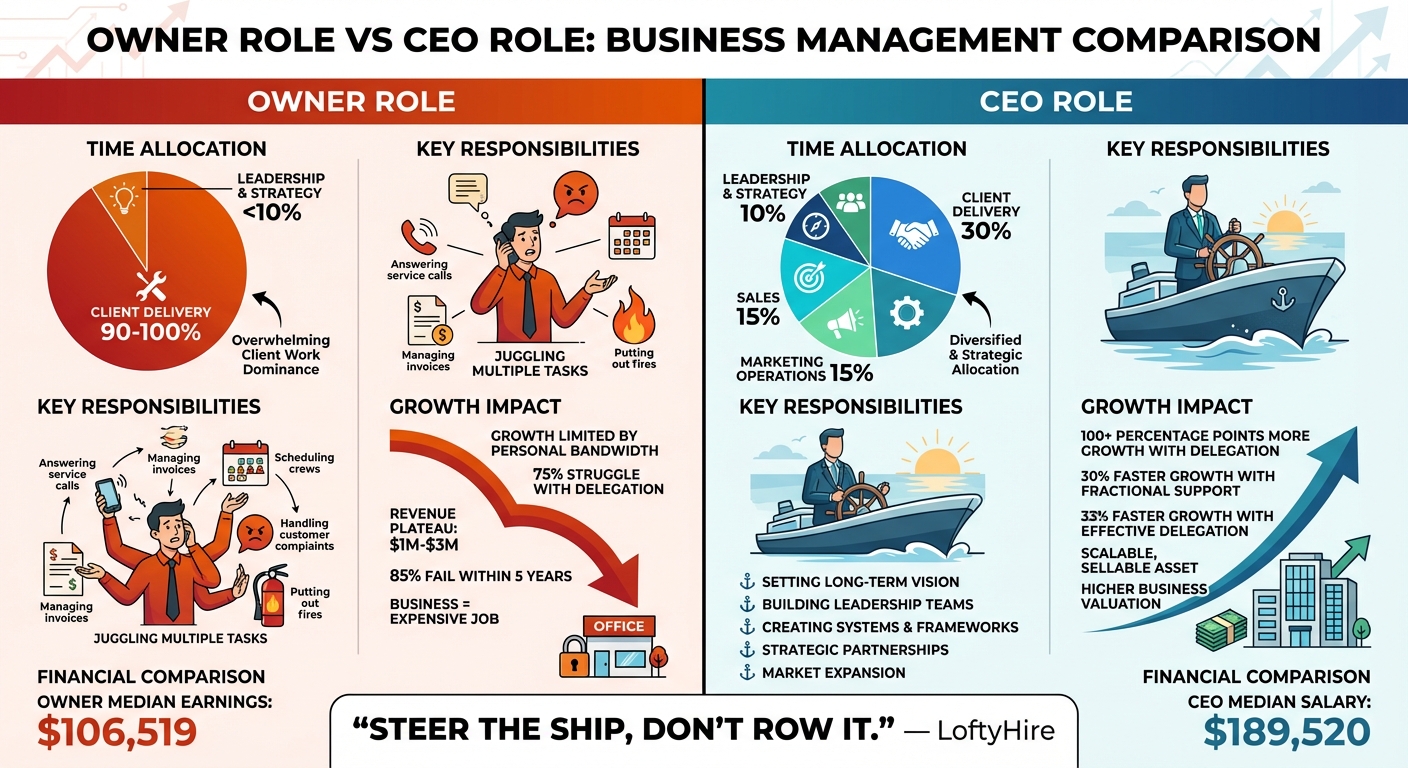
Owner vs CEO Time Allocation and Business Impact Comparison
1. Owner Role
Time Allocation
As a business owner, your days are packed with tasks like answering service calls, managing invoices, scheduling crews, running supplies to job sites, and handling customer complaints. Essentially, you're entrenched in the daily grind of client delivery, leaving little room for anything else. Ideally, in a 40-hour work week, you should set aside at least 4 hours (10%) for leadership and strategy. But let’s face it: most owners spend that time putting out fires instead. Whether it's dealing with supplier delays, staff conflicts, or last-minute client requests, the reactive nature of these responsibilities dominates your schedule, leaving little bandwidth for forward-thinking leadership.
Responsibilities
To reclaim time for strategic work, you first need to take stock of your current workload. At its core, the owner role often revolves around execution. You have to get out of the daily repetitive duties and out of your inbox. This "Technician" mindset, where you're focused on doing rather than leading, can turn your involvement into a bottleneck. It slows down decision-making, delays projects, and stifles opportunities for growth and innovation.
Impact on Business Growth
Being overly involved in operations directly limits your business's ability to grow. Research from Entrepreneur.com shows that entrepreneurs who delegate effectively achieve over 100 percentage points more growth than those who don’t. Yet, 75% of business owners struggle with delegation, creating a cycle where the company relies too heavily on their personal involvement. This dependency not only hampers scalability but also reduces the business's marketability and valuation. In fact, businesses that can't function without their owner are often seen as liabilities rather than assets. It's a sobering statistic: 85% of contractors go out of business within the first five years, largely due to their inability to implement scalable systems.
Barriers to Transition
Breaking free from the grind requires a shift in mindset. The "Technician" mentality (the belief that it's quicker and better to do everything yourself) often holds owners back. Perfectionism can make delegation feel impossible, and when critical business processes exist only in your head, your team becomes overly reliant on you for every decision. There's also a psychological hurdle: you might feel like you need more capacity to grow but think significant growth is necessary before you can justify hiring help. This vicious cycle keeps you stuck, overwhelmed, and unable to turn your business into a scalable, self-sustaining asset.
2. CEO Role
Time Allocation
Transitioning from an owner to a CEO means rethinking how you spend your time. Instead of dedicating 90–100% of your week to client delivery, as a CEO, you should aim to reduce that to just 30%. The remaining time shifts to higher-level priorities: 20% for business operations (like workflows and admin tasks), 15% for marketing, 15% for sales, 10% for leadership and strategy, and 10% for managing your internal team. This isn't about cutting back on effort; it's about focusing on the activities that drive the business forward.
"As the CEO, you should only be spending about 30% of your time on client delivery. Right now you're probably spending more like 90-100%... which can consequently decrease the quality of your services" - Abagail Pumphrey, CEO of Boss Project
This shift in time management is essential for stepping into a leadership role that prioritizes strategy and system-building over day-to-day execution.
Responsibilities
To escape being the bottleneck in your business, the CEO's role is all about designing systems that solve problems before they arise. Instead of tackling every issue yourself, you create structures that empower your team to handle challenges independently. Your responsibilities now include setting a long-term vision, defining company values, building leadership teams, and establishing decision-making frameworks. This approach allows the organization to thrive without requiring your constant input.
One key strategy is the 70% Rule, encouraging team leaders to make decisions when they're at least 70% confident in their judgment. This prevents you from micromanaging and frees up your time for higher-level priorities.
Impact on Business Growth
Shifting to a CEO mindset removes the dependency on the owner for daily operations, which is critical for breaking through revenue plateaus. Service businesses often hit a ceiling between $1 million and $3 million in revenue when the owner remains heavily involved in operations. To scale beyond that, businesses need "Orchestrator Leadership." In this model, the CEO focuses on coordinating talent, leveraging AI tools, and implementing systematic frameworks instead of handling every task personally.
The data supports this approach: companies that utilize fractional executive support grow 30% faster on average, and CEOs who delegate effectively see their businesses grow 33% faster than those who try to do it all themselves.
Barriers to Transition
Even with the right mindset, certain mental hurdles can block the shift to a CEO role. Three common obstacles often stand in the way:
- "Expertise Prison": The belief that no one else can perform tasks as well as you can.
- "Control Illusion": Confusing personal involvement with control, when real control comes from well-designed systems and accountability.
- "Hero Complex": Feeling the need to be the go-to problem solver for every issue.
"If your business can't run without your constant involvement, you haven't built a business. You've built yourself a very expensive job with unlimited overtime" - Dean Mercado, Founder and CEO of Online Marketing Muscle
Overcoming these barriers is essential for creating a scalable, sustainable business that doesn't rely on your daily presence.
How to Move from Owner Operator to CEO
Pros and Cons
Taking on the owner role gives you full control over decisions and profits but often limits how much you can grow. As an owner, you enjoy complete autonomy and direct access to profits without having to answer to a board. However, this hands-on approach has its limits. When most of your time is spent handling client work, your ability to expand is capped by how much you can personally manage. On top of that, you bear the greatest financial risk, including potential exposure to your personal assets. This reality often leads to a pivotal decision: transitioning from the owner’s hands-on role to the CEO’s strategic leadership.
Stepping into the CEO role opens up opportunities for scaling by shifting your focus from execution to strategy. Instead of spending nearly all your time on client-related tasks, you might allocate around 30% to client delivery while dedicating the rest to operations, marketing, sales, and leadership. This strategic shift often results in a business that’s more attractive to buyers, as companies with strong systems are valued higher than those reliant on a single “superhero” operator. However, this transition comes with trade-offs: you’ll have less autonomy, as you’ll report to a board and shareholders, and your earnings will shift from direct profits to a salary and bonuses.
Financially, the distinction is clear. In 2023, the median CEO salary was $189,520, compared to the average business owner’s earnings of $106,519. But there’s more to the story. CEOs typically build businesses that can run independently and be sold, while owners often create roles that are difficult to delegate or step away from.
Here’s a breakdown of how the owner and CEO roles differ:
The numbers back up the benefits of a CEO approach. Companies that use fractional executive support grow 30% faster, and entrepreneurs who delegate achieve more growth compared to those stuck in daily operations.
How to Shift from Owner to CEO
If you're stuck in the weeds of daily tasks, making the leap from business owner to strategic CEO requires a conscious shift in how you spend your time. Here's how to make that transition.
Start by tracking your daily activities for two weeks. This exercise will uncover where your time is actually going. Dan Quiggle, Author and CEO of The Quiggle Group, describes this shift as moving from "doing/tactical" work to "leading/strategic" work. Many business owners find they spend 90–100% of their time on tasks that could easily be outsourced for $10–$100 per hour, all while neglecting strategic work valued at $1,000–$10,000 per hour.
Once you've pinpointed these time-draining tasks, it’s time to delegate. Start with 5–10 hours per week of administrative work, such as managing your inbox, scheduling, or data entry. From there, move on to repetitive tasks like operations, quoting, and marketing.
Growth comes from delegation.
Next, document your most frequent workflows by creating Standard Operating Procedures (SOPs). These could include processes like client onboarding, team communication, or billing. By doing this, you eliminate the need for your constant involvement. Then, block off time on your calendar for CEO-level activities like strategic planning, vision development, and relationship building. Treat these blocks as sacred as you would a meeting with your top client.
Leverage automation tools to handle scheduling, dispatching, and invoicing. For example, here at ServiceEmpire.AI, we provide free AI tools tailored for field service businesses. These tools can help you build custom SOP templates, build hiring frameworks, create delegation systems, and access strategic planning templates. These resources are designed by operators who’ve scaled businesses to nine figures, offering practical solutions instead of just theory.
The goal isn’t to stop working hard. It’s to focus your efforts on what truly matters. Aim to allocate your time like this: 30% on client delivery, 20% on operations, 15% on marketing, 15% on sales, 10% on strategy, and 10% on leadership. For one week, classify every decision you make as either "strategic" or "tactical" to identify where you’re getting stuck.
As a wise leader once said,
"Your role now is to steer the ship, not row it."
Conclusion
Stepping into the role of CEO from being the owner isn’t about doing less. Actually, it’s about working smarter. By eliminating yourself as the bottleneck for decisions and creating systems that run on their own, your business evolves from something that relies solely on you into a scalable, independent asset. This shift not only lightens your burden but also sets your company up for long-term growth and higher valuation.
Businesses that embrace delegation often see growth, while those stuck in hands-on management face instability. These insights emphasize the importance of taking action now.
Start small. Free up 5–10 hours each week to create mental space and focus on growth. Take your top three recurring tasks and turn them into Standard Operating Procedures (SOPs). Then, carve out dedicated time for strategic planning on your calendar.
FAQs
How can I delegate tasks effectively as a business owner to focus on leadership?
Delegating well can transform your role from juggling daily tasks to steering the broader direction of your business. Start by pinpointing the time-consuming responsibilities and pairing them with team members whose skills and workload make them a good fit. To set them up for success, provide clear instructions, brief training sessions, or standard operating procedures (SOPs) tailored to the task.
Give your team the tools and trust they need by defining clear, measurable goals and letting them take ownership of the outcomes. While it's important to keep communication channels open for questions, resist the urge to micromanage. Regular performance check-ins can help maintain accountability and foster continuous improvement.
For added efficiency, consider leveraging free AI tools from ServiceEmpire.AI. These tools can help you create trade-specific SOPs, hiring templates, and leadership guides, making it easier to standardize tasks and delegate effectively. By doing so, you free up time to focus on scaling your business and achieving long-term growth.
What challenges do business owners face when transitioning to a CEO role?
The journey from being a business owner to stepping into the role of CEO often brings its own set of hurdles - both in mindset and how operations are handled. Many owners find it tough to step back from the day-to-day grind. They’re used to solving immediate issues and may feel more at ease putting out fires than mapping out a long-term vision. This hands-on approach, however, can create bottlenecks, as the owner becomes the go-to decision-maker, making it hard for the business to function smoothly without their constant input.
On the operational side, the absence of clear systems and effective delegation often traps owners in tasks like answering service calls, managing invoices, or handling other routine problems. This leaves little room for the big-picture thinking needed to shape the company’s future. To truly make the leap to CEO, owners need to embrace delegation, develop a team that can operate independently, and focus their energy on activities that drive growth and set the stage for scaling.
What are the benefits of shifting from an owner to a CEO mindset?
Shifting from thinking like an owner to acting as a CEO means stepping back from the day-to-day grind and focusing on the bigger picture, aka long-term strategy and growth. By handing off tasks and trusting your team to make decisions, you can remove bottlenecks, streamline operations, and set your business up for growth that can scale.
This shift doesn’t just drive revenue growth more quickly; it also gives you the freedom to lead with purpose, shape a clear vision, and build a company that’s stronger and positioned for lasting success. Making this mindset change is a critical step toward realizing your business’s full potential.
Lead With Confidence and Clear Direction