Evaluating technician skills is critical for ensuring efficient service, reducing errors, and maintaining customer satisfaction. A good evaluation system measures both knowledge and hands-on abilities, helping businesses assign tasks effectively and identify training needs. Here’s a quick breakdown:
- Why It Matters: Skill gaps lead to more callbacks, accidents, and inefficiencies. For example, 81% of consumers are more likely to return after good service, and proper training could prevent thousands of annual injuries in fields like HVAC.
- Common Challenges: Resumes often don’t reflect hands-on skills, interviews can miss technical gaps, and inconsistent benchmarks across companies make evaluations subjective.
- Key Skills to Measure:
- Repair & Troubleshooting: Diagnosing and fixing mechanical, electrical, and other systems.
- Problem-Solving: Logical thinking to address unexpected challenges.
- Tool Knowledge & Safety: Proper use of tools, adherence to safety protocols, and blueprint reading.
- Testing Methods:
- Written exams for theory and decision-making.
- Hands-on tasks to test practical application.
- Observations during real jobs and peer feedback for soft skills.
- Improving Evaluations: Use standardized tests, clear skill classifications (e.g., Class A to Class D), and digital tools like ServiceEmpire.AI to streamline processes.
Which Technical Skills to Measure in Field Service Technicians
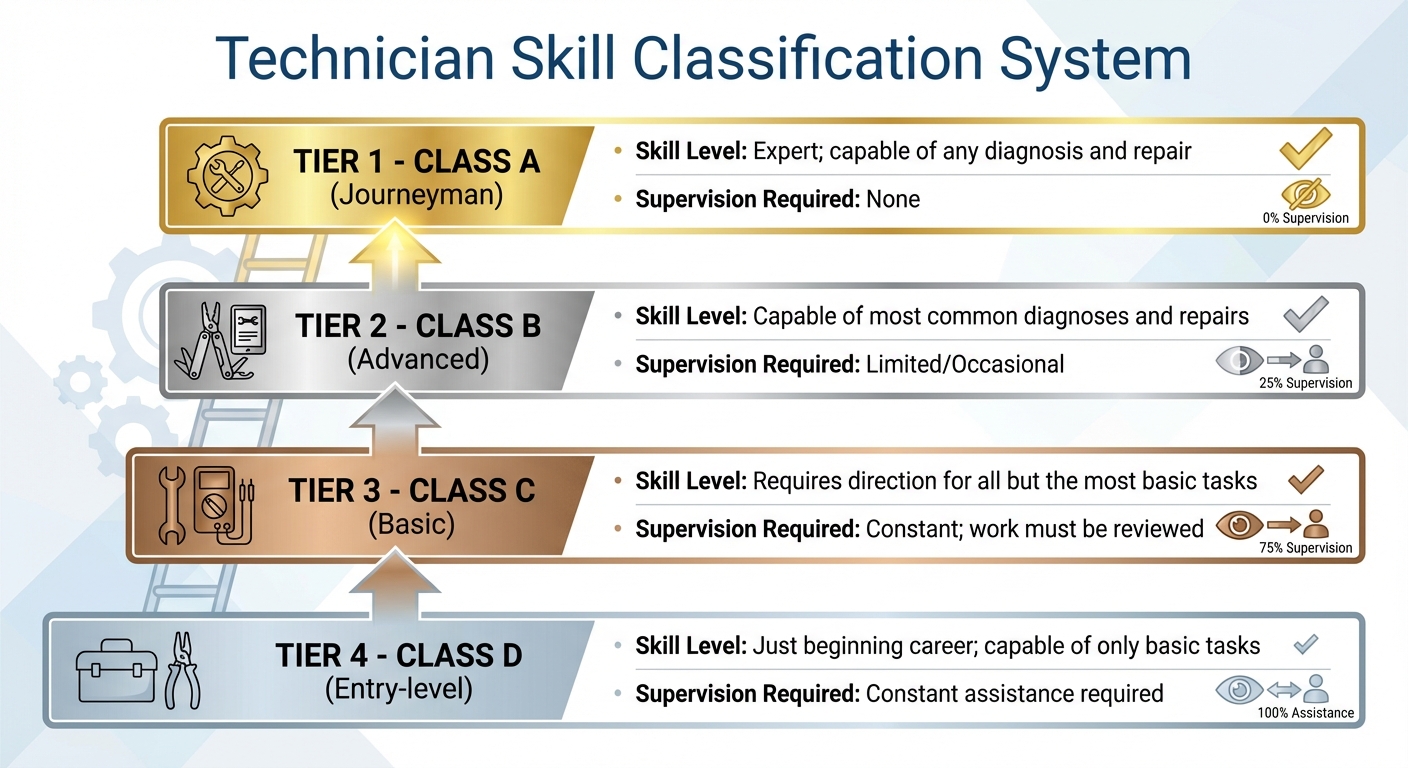
Technician Skill Classification System: Class A to Class D Levels
To properly evaluate field service technicians, you need to know which technical skills to assess. These skills generally fall into three main categories: repair and troubleshooting, problem-solving and critical thinking, and tool knowledge with safety compliance. Each plays a key role in determining whether a technician can work independently and effectively in the field.
Repair and Troubleshooting Skills
A solid grasp of mechanical, hydraulic, pneumatic, electrical, and electronic systems is essential for field service technicians. These skills involve diagnosing equipment issues, performing repairs, and even handling major overhauls when necessary. For example, a technician who can’t figure out why a compressor is failing or locate an electrical short creates more problems than they solve.
Troubleshooting requires sharp deductive reasoning to identify the root cause of a malfunction. In the field, technicians often don’t have the luxury of consulting manuals or calling for help. Their ability to diagnose issues, test components, and execute quick fixes without supervision is what sets them apart.
Problem-Solving and Critical Thinking
Field service work is unpredictable, and technicians are frequently faced with challenges that don’t have clear solutions. They need to analyze problems logically and devise solutions on the spot. This involves recognizing failure trends, testing potential fixes, and adapting as situations evolve.
"Service calls may be primarily about troubleshooting problems with no obvious solution... Your techs need the ability to think through problems to solve them, on their own." - Employtest
Another aspect of critical thinking is knowing when to escalate an issue. A technician who spends hours on a repair they aren’t equipped to handle wastes time, costs the company money, and risks frustrating the customer. The best technicians know their limits and call for assistance when necessary.
Tool Knowledge, Safety Rules, and Blueprint Reading
Proficiency with hand and power tools, as well as specialized tools like multimeters, gauges, and acetylene torches, is non-negotiable. Technicians must understand how to use and maintain these tools properly. Some hiring managers even suggest evaluating a candidate’s personal vehicle during hiring, saying if someone pulls up in a poorly maintained vehicle, it can reveal a lack of attention to maintenance tasks, also signaling that person could contribute to future fleet issues for your own team.
Safety is equally critical. Technicians must follow Lockout/Tagout (LOTO) protocols and use Personal Protective Equipment (PPE) as part of their basic safety checklists at all times. For instance, in 2020, industry stats said HVAC technicians reported over 2,400 sprains and strains, along with numerous cuts, burns, and fractures. Many of these injuries were the result of skipping safety steps or mishandling tools. If a technician skips steps or is lax about implementing lock-out tag-out (LOTO) safety procedures, it could lead to serious injuries or fatalities.
Additionally, the ability to read technical diagrams, schematics, and blueprints is vital for accurate repairs and troubleshooting. Misinterpreting a wiring diagram, for example, can lead to equipment damage, safety risks, and wasted time. Blueprint reading isn’t just a nice-to-have skill, it’s a must-have.
This classification system helps set clear expectations, simplify hiring, and identify training needs. By focusing on these technical skills, you can ensure your evaluation methods are thorough and objective.
How to Test Technician Skills
To effectively assess technician skills, it's essential to use a mix of testing methods that evaluate both their theoretical knowledge and practical abilities. Combining written exams, hands-on tasks, and observational evaluations ensures a well-rounded understanding of a technician's capabilities.
Written Tests and Knowledge Checks
Written exams are a quick and efficient way to measure theoretical knowledge and recall of key information. These tests often include multiple-choice questions, image identification, and gauge reading exercises to evaluate a candidate's understanding of concepts. They’re especially useful early in the hiring process, helping to screen out candidates who lack basic knowledge before moving forward with interviews.
A great example is the "Technician A/Technician B" challenge, which tests mental agility and decision-making. For instance, Technician A might attribute a compressor failure to low refrigerant, while Technician B blames a faulty capacitor. Candidates need to identify the correct explanation, demonstrating their analytical skills.
"A technician who has a solid grasp on only one topic... could indicate a technician who can learn and retain information, making the individual a good candidate for further training." - Christopher Prioli, Maintenance Expert
Written tests become even more effective when paired with pre- and post-training assessments. Administer the same test before and after training sessions to track knowledge improvement, and follow up after 90 days to check for retention. If a candidate already holds certifications like NATE (North American Technician Excellence), you might consider skipping internal knowledge tests.
While written tests evaluate theory, hands-on assessments validate the ability to apply that knowledge in real-world scenarios.
Hands-On Testing
Hands-on tests challenge technicians to perform tasks like diagnosing and repairing equipment. For example, you could ask a candidate to troubleshoot a malfunctioning HVAC unit, pinpoint the issue, and implement a solution while being observed.
Another helpful method is visual literacy testing. Show candidates images or diagrams of mechanical, hydraulic, or pneumatic systems, and ask them to explain how they work or identify potential failure points. This mirrors real-life situations where technicians must interpret schematics and blueprints on the spot.
These tests reveal whether a technician's theoretical knowledge translates into effective problem-solving and repairs. For instance, someone might excel in a written exam on electrical systems but struggle to locate a short circuit during hands-on testing. Identifying such gaps early prevents costly mistakes later on.
Beyond structured tests, real-world observations provide deeper insights into a technician's readiness.
Job Observations and Peer Feedback
Watching technicians during actual service calls offers a glimpse into how they perform under pressure, interact with customers, and adapt when unexpected challenges arise. Observations also highlight soft skills like leadership, decision-making, and communication, which are just as critical to their success.
Peer feedback is another valuable tool. Coworkers often notice things that supervisors might miss, such as daily work habits, team interactions, and how a technician handles challenges when no one is watching. Pat Vaughn from Simpatico uses this approach to identify skill gaps within his team:
"If we're all glaringly missing something, or lacking in a specific technology, then I can pull everybody together and do a group training or boot camp to fill that gap." - Pat Vaughn, Simpatico
To ensure fairness, use standardized checklists and train evaluators to score consistently. A 360-degree feedback system, where peers, supervisors, and even subordinates contribute to the evaluation, can offer a more comprehensive view. For rare or high-stakes scenarios, simulation exercises allow technicians to demonstrate problem-solving and decision-making in a controlled setting.
A practical strategy is to have Class A (Journeyman) technicians review the work of Class C technicians. This approach not only evaluates the less experienced team members but also fosters mentorship and quality control. Considering that 81% of consumers say good customer service encourages repeat business, these observations help assess both technical expertise and customer-facing skills effectively.
How to Build a Complete Skill Evaluation System
Using Multiple Testing Methods Together
Creating a thorough skill evaluation system means blending theoretical tests with practical assessments to ensure that knowledge translates into on-the-job performance. Observing employees in action and gathering peer feedback can highlight soft skills like teamwork and customer service - qualities that play a big role in customer satisfaction and retention. This comprehensive strategy helps establish measurable performance benchmarks.
Start with written or online tests to confirm foundational knowledge before moving on to more hands-on evaluations. Once theoretical understanding is verified, practical tasks such as diagnostics and repair assessments can test manual skills and problem-solving speed. Finally, job shadowing and peer reviews provide insight into how technicians handle real-world challenges, including working under pressure and interacting with customers.
Setting Clear Metrics and Feedback Systems
To complement these diverse testing methods, clear performance metrics are essential. A tiered classification system, such as Class A through Class D, can define skill levels and provide a transparent pathway for growth. For instance:
Each level builds on the previous one, making career progression straightforward and measurable.
Instead of relying on a single overall score, track performance in specific areas like electrical systems, hydraulics, or HVAC. This approach can reveal niche strengths or areas requiring improvement. For example, a technician might struggle with general tests but excel in a specialized skill, pointing to where focused training could make a difference. Use pre- and post-training tests to measure short-term learning and re-test after 90 days to gauge long-term retention.
CEC highlights the value of this method:
"This has given us a baseline for where a technical team member should be either during recruitment or promotion. It can also be used to identify gaps in training for our team's professional development plans."
Tie career advancement to professional certifications like NATE. Progress on these certification tracks can serve as formal criteria during annual reviews and for determining wage increases. To encourage ongoing learning, offer hourly incentive bonuses for passed certification exams and reimburse testing fees.
Using Templates and Tools for Consistent Evaluations
Consistency is key when applying these metrics, and standardized templates and digital tools can help ensure fairness. Templates provide a uniform structure for evaluations, making feedback more objective and data-driven instead of relying on subjective opinions. Spread questions across various topics to assess adaptability and reduce the chance of predictable patterns.
Digital tools can go a step further by creating a "skill map" of your workforce. This allows you to identify experts for specific tasks and pinpoint areas where training investments are needed. For example, in 2025, Unity's Global Head of Recruitment, Chris Weber, shared that the company used Codility to run 750 candidate tests over 90 days, saving 2,200 hours of interview time. While this example comes from the tech sector, the same principle applies to field services: standardized processes reduce bias and let data guide decisions.
Train supervisors to apply these standards consistently and implement a 360-degree feedback system where peers, managers, and even subordinates contribute to the evaluation process. This ensures a well-rounded and accurate assessment of each individual's performance.
Using ServiceEmpire.AI for Technician Skill Testing
Why start from scratch when you don’t have to?
Advanced AI tools are changing how businesses evaluate technician skills, making the process more efficient and tailored. Here at ServiceEmpire.AI, our free tools can help you create and implement technician assessments with ease. ServiceEmpire.AI also simplifies the process of building trade-specific Standard Operating Procedures (SOPs) and skill matrices for your field service business. Whether you’re in HVAC, plumbing, electrical services, or another sector, this platform helps you standardize technician procedures with minimal effort.
Just answer a few targeted questions, and you’ll receive customized SOPs that align with your operations. If you need to define what knowledge and skills a top-tier Class A technician should have compared to an entry-level Class D hire, you can do that easily. This lets you design clear evaluation frameworks, ensuring consistent assessments across teams and locations.
Hiring and onboarding don’t have to be a headache either. We have structured interview prompts, onboarding systems, and management 1-1 templates. The result? A smoother onboarding process that sets technicians up for success from day one while reducing turnover.
Finally, our Field Service Insights Blog features over 100 articles written by experienced operators who’ve scaled service businesses to impressive eight- and nine-figure revenues. Topics include SOP creation, leadership strategies, company culture, and long-term planning, offering practical advice grounded in real-world experience.
The best part? The platform is completely free. No credit card required. You’ll have access to 18 AI tool categories and over 100 prompts, covering everything from hiring scripts to leadership frameworks and systems for tracking technician performance. We created a comprehensive resource designed to help you elevate your technician evaluation process without breaking the bank.
Conclusion
Building a reliable technician team starts with consistent and fair evaluations that incorporate various testing methods. This balanced approach helps avoid the common pitfall of hiring technicians who might shine on paper but fall short in real-world performance.
Standardized testing plays a crucial role in removing bias from hiring and promotion decisions. By relying on uniform assessments, you ensure that decisions are driven by data rather than subjective opinions.
Evaluation systems categorize technicians into clear skill levels. From entry-level Class D technicians who require close supervision to Class A journeymen capable of handling any diagnosis independently, these classifications provide a roadmap for immediate improvements and better team management.
To put these strategies into action, start by refining your candidate screening process. Clearly define the technical and soft skills required for the role and incorporate written tests, hands-on tasks, and field evaluations. Prioritize testing candidates before committing to lengthy interviews, as this can save you significant time, weeding out unqualified applicants early.
If you're looking for tools to simplify this process, ServiceEmpire.AI offers ready-made frameworks, templates, and AI-powered solutions tailored for field service businesses. You’ll find trade-specific SOP generators, skill matrices that outline the difference between a Class A technician and an entry-level hire, and hiring prompts to streamline your process. Best of all, the platform is free to use - no credit card required. Click the black box below to start building a skilled and accountable technician team today.
FAQs
What skills should you assess in a field service technician?
When assessing a field service technician, it's essential to look at both technical skills and interpersonal abilities. On the technical side, this means evaluating their ability to diagnose equipment problems, carry out repairs, follow safety protocols, and comply with industry standards. Skills like problem-solving, critical thinking, and basic math play a big role in troubleshooting and ensuring precise calculations.
Just as important are the soft skills that foster effective communication and collaboration. These include customer service, active listening, and teamwork, which help technicians build trust with clients and work seamlessly with colleagues. Traits like dependability, flexibility, and the capacity to handle unexpected situations are also hallmarks of a strong technician.
With ServiceEmpire.AI, you can simplify this evaluation process. Our free AI-powered tools allow you to assess both technical expertise and interpersonal skills, making it easier to spot top talent and address any skill gaps along the way.
How does standardized testing improve technician evaluations?
Standardized testing gives field service managers a reliable way to assess a technician's knowledge and hands-on skills. By applying the same set of questions or scenarios to all candidates and employees, it ensures fairness, consistency, and establishes clear performance benchmarks.
These tests are especially useful for spotting skill gaps, which allows for focused training and measurable progress over time. ServiceEmpire.AI provides free, AI-driven tools crafted by industry veterans who have hired hundreds of technicians and built nine-figure service businesses. Our tools and industry-leading blog help managers hire top talent, certify their teams, and maintain high levels of technical expertise.
How can I effectively assess a technician's technical skills?
Evaluating a technician’s technical skills isn’t always straightforward, but it’s a step you can’t skip if you want to deliver quality work and keep customers happy. The process starts with clearly identifying the skills that are critical for the job - whether it’s troubleshooting issues, handling equipment, or mastering specific software tools. To get a true sense of their abilities, consider using hands-on tests, role-specific challenges, or scenarios that mimic real-world situations.
For a more organized and efficient approach, ServiceEmpire.AI can help. Our tools allow you to design trade-specific evaluation frameworks, complete with AI-generated SOPs and hiring prompts. This not only simplifies the assessment process but also helps you attract skilled professionals, ensuring your team is ready to perform at its best.
Lead With Confidence and Clear Direction