Want to price your field services correctly without leaving money on the table? Here's the bottom line: analyzing competitor pricing is a must if you want to stay competitive and profitable. Many businesses either guess their rates or copy competitors blindly. Both approaches can hurt your bottom line. Instead, use a structured process to:
- Identify your competitors and understand their pricing models.
- Collect accurate pricing data from public sources, direct inquiries, and customer reviews.
- Standardize and compare pricing to ensure you're competitive without undercutting.
- Calculate your minimum viable rate based on costs and desired profit margins.
- Use competitor insights to offer premium services or stand out with certifications and trust signals.
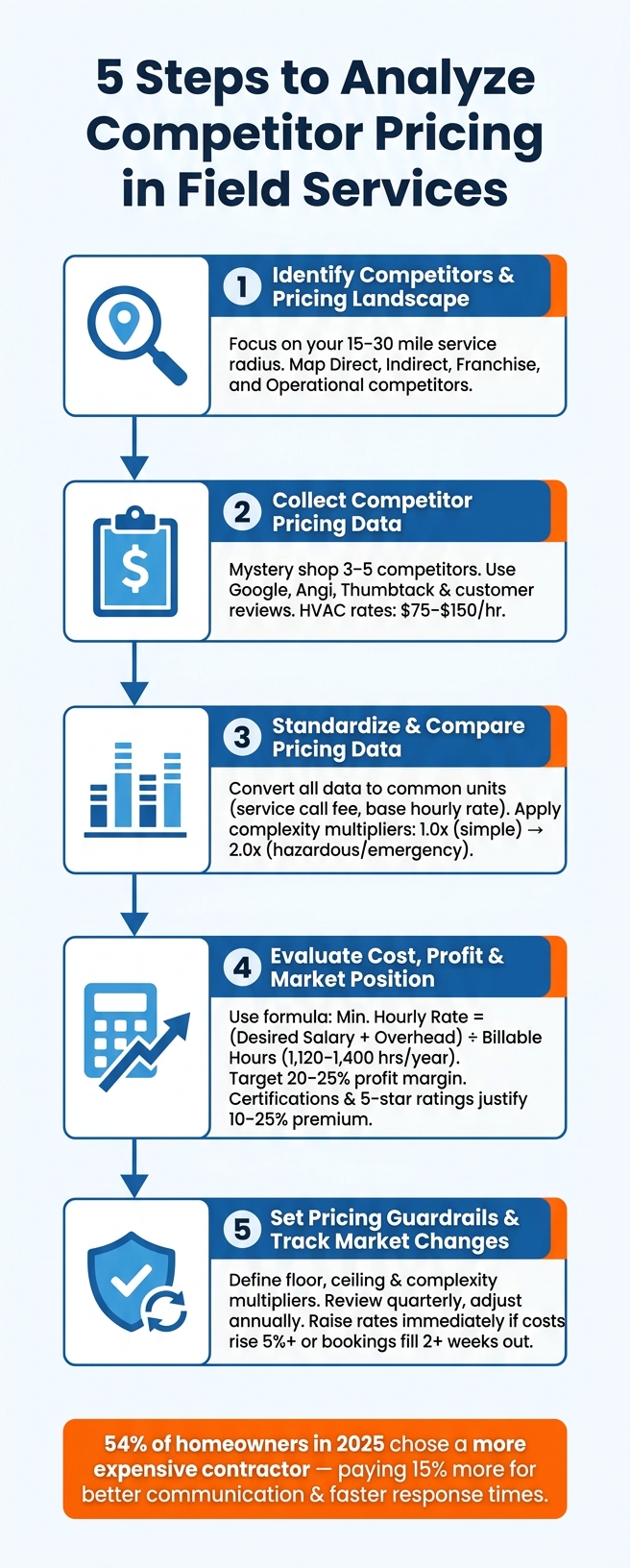
5-Step Competitor Pricing Analysis for Field Service Businesses
How To Find Business Competitors: Competitor Analysis Tool For Local Businesses
Step 1: Identify Your Competitors and Pricing Landscape
The first step is zeroing in on the right competitors. Comparing yourself to businesses that don’t align with your services or market will only lead to bad data and poor pricing choices.
Define Your Target Market and Service Scope
Before you look outward, take a hard look at your own business. Ask yourself: What services do we offer? Who are our customers? Residential homeowners, property managers, or commercial clients? And where do we operate? Most field service businesses stick within a 15–30 mile radius. That’s your competitive playing field.
Your market type has a big impact on pricing. Urban areas like New York City or San Francisco can command rates 30–50% higher than the national average, while rural markets often fall 15–25% below it. For instance, an HVAC contractor in suburban Atlanta charging $90/hour isn’t competing with a Manhattan-based contractor charging $160/hour, even if the services are identical.
The most common mistake we see is trying to market to everyone. Dial in your demographic and socioeconomic status. Dial in your location. Dial in your owner types, residential vs. property managers vs. commercial vs. industrial.
Once you’ve nailed down your market, it’s time to figure out which competitors are targeting the same customers.
Map Competitor Services and Job Types
With your market clearly defined, start identifying competitors who serve the same audience. Focus on these four key types of competitors:
- Direct: Local businesses offering the same trade within your service area.
- Indirect: Handymen or multi-service providers with overlapping offerings.
- Franchise: National brands running suburb-specific campaigns to attract local customers.
- Operational: Competitors identified through public permit records rather than online search
Use local keywords (e.g., "plumber in [your city]") to find competitors on Google Maps, Google Business Profiles, and Local Service Ads. Platforms like HomeAdvisor, Thumbtack, and Angie's List are also great for spotting active providers. Don’t overlook local Facebook groups and apps like Nextdoor, where real customers share recommendations and critiques. On the ground, branded vehicles and yard signs in your target neighborhoods can reveal who’s actively working in your area.
Understanding your competitors’ job focus is just as important as knowing their names. A company specializing in emergency after-hours calls will price differently than one focused on maintenance contracts. Similarly, job complexity plays a huge role in pricing. Routine tasks like replacing a faucet might stick to a 1.0x base rate, while complex jobs (with hazardous conditions or tight spaces) can justify a 1.5x–2.0x multiplier. Breaking competitors down by these categories helps you see not just what they charge, but why.
Step 2: Collect Competitor Pricing Data
To set competitive rates, you’ll need to understand what others in your industry charge. This involves a mix of online research, direct outreach, and analyzing customer feedback.
Use Publicly Available Sources
Start by exploring online platforms where pricing information is often shared. Many service websites list pricing details, although some might require you to fill out quote forms to get exact rates. Platforms like Google Business Profiles, Angi, Thumbtack, and Nextdoor can provide helpful "starting at" prices and customer reviews that hint at pricing trends. Google AI Overviews can also help identify local pricing patterns.
Another useful tactic is to review job postings for HVAC technicians. These postings often include wage information, which can help you estimate labor costs and markups. For instance, HVAC contractors typically charge between $75 and $150 per hour, reflecting a markup of about 3 to 3.5 times the employee wages. Additionally, industry trade associations or contacts at local supply houses might offer insights into which contractors are commanding higher rates in your area.
To confirm your findings, consider reaching out to competitors directly.
Request Quotes and Estimates
Mystery shopping is a practical way to gather accurate pricing information. Call 3 to 5 competitors in your area and ask consistent questions, such as:
- "What’s your hourly rate?"
- "Do you charge for travel time?"
- "What’s the flat fee for a standard repair?"
Keep a detailed log of each call, noting rates, additional fees, and any other relevant details.
In addition to direct inquiries, customer reviews can provide valuable clues about pricing.
Read Customer Reviews for Pricing Clues
Customer reviews are an often-overlooked goldmine for pricing insights. Many reviews mention specific costs, comparisons, or hidden fees. For example, a comment like "they were the highest of three bids but worth every penny" suggests the competitor charges at the higher end but delivers value that justifies it.
Pay attention to negative reviews that highlight hidden fees, such as diagnostic charges, travel fees, or minimum order requirements. On the flip side, positive reviews that praise quick response times or seamless online booking might indicate that a competitor’s premium pricing is supported by excellent service.
In fact, companies with 50 or more Google reviews and an average rating above 4.2 tend to convert customers at higher rate than competitors with lower ratings. Think about yourself as a customer: you're skeptical of a business with lower than 4/5 stars. So is the average consumer.
Step 3: Standardize and Compare Pricing Data
Raw pricing data on its own doesn’t provide much insight. It needs to be adjusted into a format that allows for meaningful comparisons. For instance, comparing a plumber charging $450 for a water heater installation to another who charges $95 per hour isn’t feasible until their pricing structures are aligned.
Build a Pricing Comparison Framework
To create a level playing field, convert all pricing data into common units: a service call fee, first-hour rate, and additional-hour rate. This approach provides a consistent baseline for comparison. You’ll also want to apply complexity multipliers based on the nature of the job. For example:
Additionally, consider regional cost differences. In cities like New York or San Francisco, rates might hover around $120 per hour, while rural areas often range between $40 and $75 per hour.
Create a Competitor Pricing Table
Once you’ve standardized the data, organize your findings into a clear and concise table. Here’s an example for an HVAC business operating in an urban area:
Competitors with strong trust signals (such as a 5-star rating or certifications like NATE) can often charge more than the baseline market rate. This table not only shows how your pricing compares to others but also highlights areas where you could adjust rates while remaining competitive. It’s a valuable foundation for examining costs, profit margins, and your overall market positioning as you move forward.
Step 4: Evaluate Cost, Profit, and Market Position
Now that your competitor pricing table is complete, it’s time to use this information to ensure profitability and carve out a competitive edge. This step will help you confirm whether your rates align with internal cost requirements and identify where you can stand out in the market.
Compare Competitor Pricing to Your Internal Costs
Before you decide if a competitor’s pricing poses a threat, you need to calculate your minimum viable rate. Use this formula:
Minimum Hourly Rate = (Desired Salary + Annual Overhead) ÷ Billable Hours
Keep in mind that you’re unlikely to hit 40 billable hours every week. Realistically, you should expect around 1,120–1,400 billable hours per year due to travel, quoting jobs, and administrative tasks. This adjustment is crucial. It can mean the difference between setting a competitive rate and unintentionally underpricing your services.
Once you’ve determined your minimum rate, compare it to national averages, particularly close to your nearest metro area. Here’s some data for reference:
Don’t forget to account for your labor burden rate, which includes payroll taxes, workers’ compensation, and health insurance. These factors reveal the true cost of employing a technician. Typically, a markup of 2.5x to 3.5x on employee wages covers these costs while securing a 20–25% profit margin. Your rate must cover tools, vehicle costs, insurance, overhead, and taxes while ensuring profit.
Once you’ve identified your minimum rate, look for ways to charge a premium by improving service quality or offering specialized services.
Find Opportunities to Differentiate Your Pricing
With your minimum rate established, the next step is to uncover ways to stand out and capture additional revenue. Competitor pricing data isn’t just a benchmark, it’s a guide to identifying opportunities. For instance, if competitors lack strong trust signals or certifications, you can use these gaps to your advantage.
Trust signals such as a 5-star Google rating can allow you to charge 10–15% more than market rates. Similarly, certifications like NATE for HVAC professionals can justify a 15–25% premium. If your business already has these advantages but is priced at the market average, you could be leaving money on the table.
Another strategy to boost revenue is tiered pricing. By offering repair, replace, and upgrade options, you can shift the focus from a simple price comparison to a conversation about what best meets the customer’s needs. This approach has been shown to increase the average ticket size by 18%.
You should also look for unmet needs in your local market. For example, if competitors don’t advertise services like emergency after-hours assistance, crawl space work, or maintenance subscriptions, adding these to your offerings can help you stand out.
The data from our 2026 Home Services Stats backs this up: among all generations, 70%+ of homeowners would pay more for a Pro with a better service reputation because they valued faster response times and clearer communication. These customers paid an average premium of 15%. This shows that when customers prioritize quality and experience, you have a clear opportunity to adjust your pricing to reflect the value you provide.
Step 5: Set Pricing Guardrails and Track Market Changes
Develop Pricing Guardrails
Competitor pricing is helpful, but only if it helps you define boundaries for your margins like your floor, ceiling, and specific adjustments for unique jobs.
For jobs with added risks or complexities, you should apply complexity multipliers. While standard rates work for routine calls, situations like tight crawl spaces, rooftop access, or hazardous environments warrant a surcharge. Typically, this means 1.2x–1.5x for medium complexity and 1.5x–2.0x for high complexity. Additionally, use a 1.1 safety factor on estimated hours to protect against scope creep.
Another key guardrail is a discount approval rule. When technicians calculate labor and parts on the spot, they might offer informal discounts to close a deal, which can eat into your margins. Flat-rate pricing solves this by removing guesswork and preventing profit loss.
Once you've established these pricing guardrails, it's essential to revisit them regularly to stay in sync with market trends.
Review and Update Pricing on a Regular Schedule
Guardrails are your starting point, but regular updates ensure your pricing remains competitive and profitable in a changing market.
Recent data shows that rates have risen 8% overall, with HVAC repair tickets jumping 47%. If your rates haven't kept pace, your margins may be shrinking.
One of the best ways to handle this is to review rates quarterly, adjust annually. Raise immediately when business costs increase 5%+, you're booked solid, or competitors increase their pricing.
To monitor market trends, do what I mentioned above and call 3–5 competitors to compare service call fees, hourly rates, and travel charges. Platforms like Thumbtack and HomeAdvisor can provide local benchmarks, and supply house contacts often have insights into which contractors are busiest and what they're charging.
Internally, track these four KPIs for each technician to ensure your pricing strategy is effective: conversion rate (aim for at least 30%), average ticket size, membership attachment rate, and financing offer rate. If these metrics drop, it could signal issues with pricing or execution in the field, not necessarily a need to lower your rates.
How to Use ServiceEmpire.AI for Pricing Analysis
ServiceEmpire.AI takes your competitor pricing framework to the next level by offering tools that help you act with precision. Designed specifically for field service businesses like HVAC, plumbing, electrical work, pool cleaning, landscaping, and garage door services, this free AI toolbox was created by operators who’ve scaled businesses to 9-figure revenues. No credit card is required, making it accessible for businesses ready to refine their approach.
Many field service owners rely on intuition when it comes to pricing. ServiceEmpire.AI replaces guesswork with a structured, repeatable process. Its Strategic Planning prompts guide you through a few targeted questions about your trade, market, and pricing challenges. In return, the AI generates step-by-step strategies tailored to your business.
You could also use the Profit Margin Calculator. Before you compare your pricing with competitors, it’s critical to understand your own minimum hourly rate, what’s often referred to as your “floor.” This rate accounts for factors like salaries, overhead, and billable hours. The calculator highlights areas where margins can slip, such as inventory inflation or inaccurate job estimates. Skipping this analysis can cost home service businesses a ton due to misaligned pricing and poor visibility into the customer journey.
Once you’ve benchmarked your pricing, the next challenge is consistent execution. ServiceEmpire.AI helps with this by providing tools to standardize your processes. Its custom SOP Template Builder is designed to create trade-specific standard operating procedures (SOPs) that can be applied across multiple crews or locations.
You can also use the Marketing and Paid Traffic Prompts to come up with your new campaigns. Carlos, an HVAC team lead, shared his experience: "Before I even hired a coach, this tool gave me 5 marketing campaigns that booked us solid for 3 weeks." With its prompt-driven system, you simply describe your business challenge, and the AI builds a framework ready for immediate implementation. Large home service companies often spend $3,000–$8,000 per month on similar services, but ServiceEmpire.AI delivers this level of marketing guidance and operational support at no cost.
Conclusion: How to Stay Competitive Without Cutting Into Profit
Chasing the lowest price in the market might seem like a quick way to attract customers, but it’s a race to the bottom. When margins are squeezed too tightly, there’s little left to sustain or grow your business. Successful field service companies know that long-term success isn’t about being the cheapest; it’s about pricing smartly, based on real costs and the value you provide.
A key takeaway: customers are often willing to pay more for quality and reliability.
The right approach to pricing goes beyond simply reacting to competitors. It starts with a clear understanding of your costs and ensuring your prices reflect the value you bring to the table. Instead of trying to undercut others dollar for dollar, focus on offering trusted service signals that justify a higher price point. Customers will pay for peace of mind when your value is evident.
This philosophy also opens doors to smarter revenue strategies. Subscription maintenance programs can provide steady, recurring income that covers fixed expenses, reducing the need to slash prices during slow periods. Additionally, contractors using "Good-Better-Best" proposals will increase their average ticket size, because customers who want more value will invest more.
FAQs
How do I find the right local competitors to price against?
Begin by clearly defining your service area and pinpointing businesses that cater to the same customer base as you. Pay close attention to direct competitors offering similar services in your vicinity. To streamline this process, tools like ServiceEmpire.AI can provide structured frameworks to evaluate competitors thoroughly.
Dig into your competitors' online presence, customer reviews, and marketing efforts to understand market rates and identify potential service gaps. This research can reveal opportunities to differentiate your business. When setting your prices, focus on a value-based pricing strategy - this ensures you cover costs while maintaining healthy profit margins.
What’s the best way to compare flat-rate prices to hourly rates?
To weigh flat-rate pricing against hourly rates, start by calculating your real business costs. Factor in everything: insurance, vehicle maintenance, taxes, and even non-billable hours. This will help you determine your actual hourly rate. Once you’ve nailed down those baseline expenses, evaluate whether a flat-rate model can cover them while leaving room for healthy profit margins. Tools like ServiceEmpire.AI can help you fine-tune your pricing approach to balance profitability with quality.
How do I calculate my minimum hourly rate without underpricing?
To figure out your minimum hourly rate, start by identifying your target annual income and estimating your realistic billable hours per year. Many people mistakenly assume a full 2,080 working hours, but once you factor in non-billable tasks like travel, administrative duties, and downtime, this often drops to somewhere between 1,120 and 1,400 hours. Don’t forget to include all your expenses, overhead, and a cushion for unforeseen costs. Tools like ServiceEmpire.AI can help you break down these numbers accurately and grow your business.
Ready to Write Copy That Commands Attention and Drives Sales?